
The holidays are hard when your energy is unpredictable. Your routines get interrupted, your energy gets stretched, and there’s a quiet pressure to be cheerful, available, and capable all at once. If you’re a midlife woman living with chronic illness, that pressure lands differently. Needing more rest than the season allows is not a personal failing.
Here’s how I think about it. A self-love practice is any small, regular way you take care of yourself with kindness and self-compassion. It’s part of looking after your health, and it matters most when life gets loud.
The usual advice is to stay consistent. But consistency is built for bodies that behave the same way every day, and yours might not. So instead of asking “How do I stay consistent?”, try a better question: “How do I make my practice flexible enough to survive a hard day?”
Here’s what helps.
1. Plan your three versions now
This is the heart of the Low Tide Method. Everything you do for yourself gets three versions, planned ahead of time:
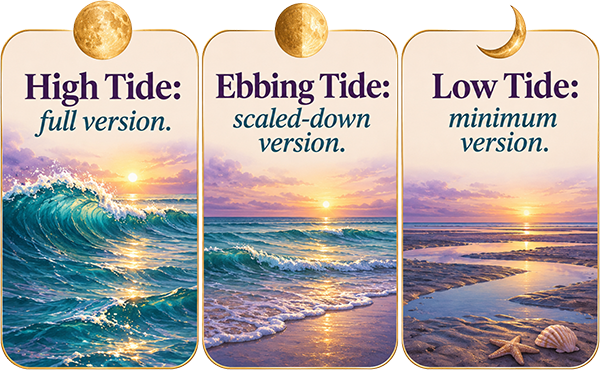
High Tide is your full version, for days with plenty of energy.
Ebbing Tide is your scaled-down version, for days when your energy is fading.
Low Tide is your minimum version, for the days when even the basics are hard.
Take a morning walk. On a High Tide day, that’s twenty minutes outside. On an Ebbing Tide day, it’s five minutes around the yard. On a Low Tide day, it’s standing at the open front door for three slow breaths.
It’s the same practice, just smaller. The minimum should be almost laughably small: one slow breath, a sip of water on purpose, one kind sentence to yourself. When the day gets loud, you don’t have to think. You just choose the version that fits.
2. Pick your minimum before the busy days arrive
The worst time to decide what to do on a hard day is in the middle of one. So do it now, while you can think clearly.
Finish this sentence: “On my hardest day this season, my minimum is ______.”
Write it somewhere you’ll see it, like your phone notes or the fridge. When the day arrives, there’s nothing to figure out. You just follow the note.
3. Name the pressure points ahead of time
Look at the calendar and ask which days will cost you the most. A gathering. A long drive. A week of visitors. A day with back-to-back plans.
Mark them, then give those days the minimum version on purpose. When it’s planned, it’s a decision and not a failure. You’re also allowed to protect the recovery days around them. If a big day is coming, leave the day after it as open as you can, and treat it as a Low Tide day before you even need one.
4. Protect one small thing
When the days get away from you, you can’t protect everything. So pick one anchor, one tiny thing you’ll keep no matter what. Maybe it’s a hot drink in silence before anyone wakes up. Maybe it’s two minutes in a quiet room before bed.
One small anchor holds more than a perfect routine that falls apart by December 15th. On the days when everything else slips, it’s proof that you’re still showing up for yourself.
5. Let the return be the practice
You will miss days. Everyone does, especially in December. What builds a practice that lasts isn’t an unbroken streak. It’s how gently you come back.
So skip the catch-up and skip the apology. You don’t owe anyone an explanation, including yourself. A missed day never has to mean starting over or giving up. It just means it was a Low Tide day, and tomorrow you pick up your next smallest version.
6. Count rest as part of the practice
Rest isn’t what happens when your practice stops. It’s one of the practices. Lying down with the lights low counts. Saying no to an invitation counts. Leaving a gathering early counts. You don’t have to earn your rest.
A few small things for the days themselves
If the whole season feels like too much, here are some low-effort options:
Arrive late or leave early, and decide that before you go.
Keep a “go-to” answer ready for when someone asks why you’re resting, like “I’m pacing myself this year.”
Ask for one job that fits your energy, like setting the table instead of cooking.
Build in a quiet fifteen minutes in the middle of a long day.
If you have food or medical needs, they come first. Plan around your usual routine as best you can.
None of this means you’re doing the holidays wrong. It means you’re a person with a limited energy budget, doing the math, and that’s smart.
Build your plan with company
If you’d like support while you do this, my free community, Sacred Self Sanctuary, is for midlife women with chronic illness and unpredictable energy. We learn the Low Tide Method together, with no pressure and no starting over.
And if you want the full method, the Low Tide membership inside the community includes a 7-module course with workbooks, a list of 100 practice ideas sorted by energy level, and live coaching calls with me. Module 2, Building Your Three Tides, walks you through setting up your High, Ebbing, and Low Tide versions step by step.
Join us here: https://www.skool.com/sacred-self-sanctuary-1128/about
This is how you build a REAL self-love practice, not the performative kind. And taking care of yourself matters for your health: mind, heart, and body.
You don’t have to earn your rest. Come as you are.